
Thursday, October 1, 2026
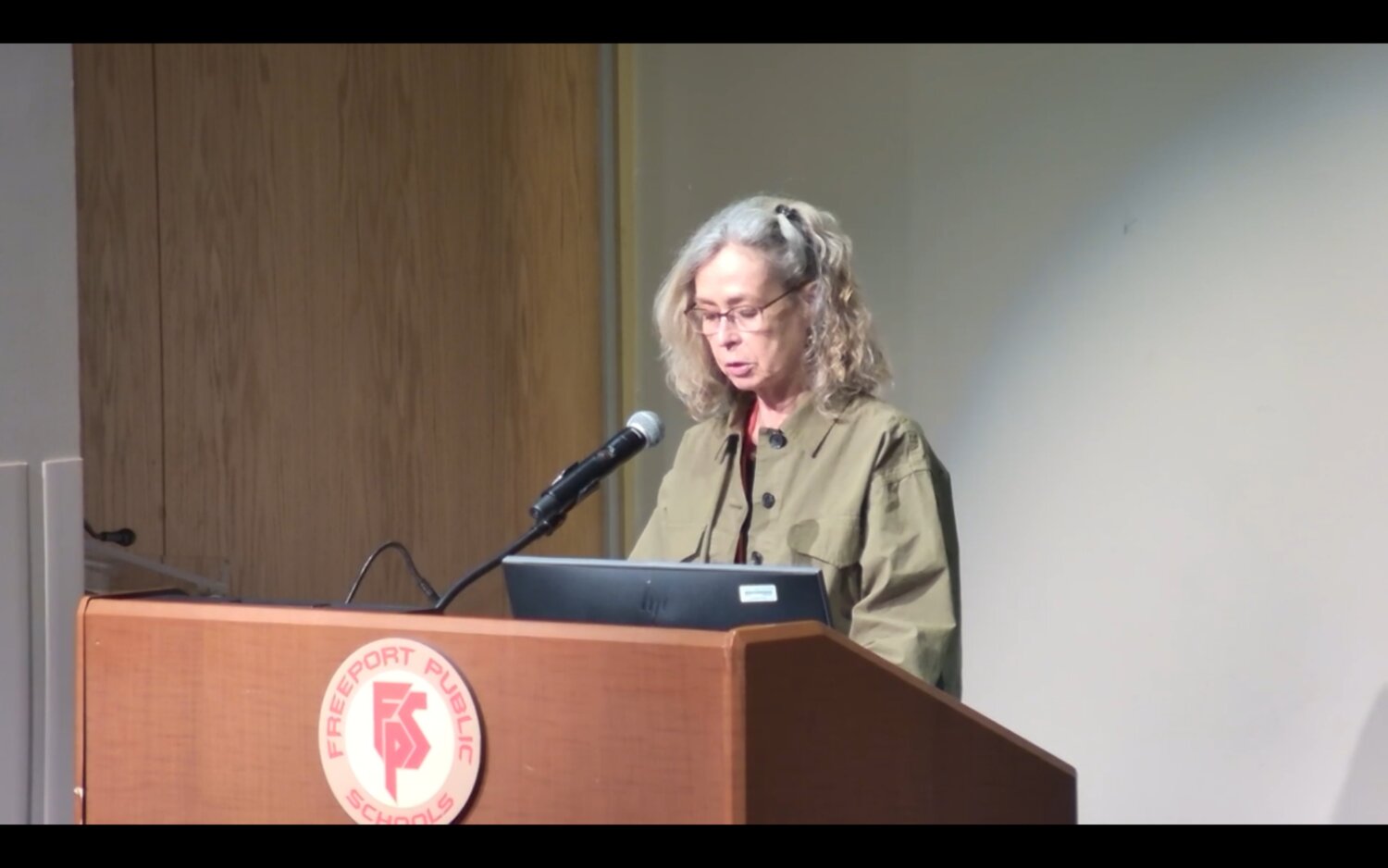
The Freeport Board of Education held its first town hall meeting on Monday, inviting questions from the community and embarking on a new effort to foster transparency, increase engagement, and build trust around district leadership and administrative and security initiatives.
Sunday Coward, the board’s president, presided over the meeting, held in the evening in the Freeport High School auditorium. The inaugural meeting focused on the status of the district superintendent’s position, the reorganization of its administrative structure, the rationale for a new biometric entry system, and the legal protocols guiding meetings and board conduct.
Coward welcomed attendees by outlining the board’s renewed priorities.
“Board governance is developing policy, exercising financial oversight, hiring and supervising the superintendent, engaging the community, and setting accountability goals,” she said.
The inaugural event aimed to reinforce the district’s commitment to transparency and stakeholder engagement, with Coward vowing “visionary leadership requires boldness and persistence. We must remain steadfast even in the face of adversity. Together with transparency, collaboration and a shared commitment to our students, we can strengthen our district and move forward with clarity and purpose.”
The board addressed one of the evening’s most pressing concerns — the status of the superintendent’s post. Alice Kane was appointed interim superintendent, taking over for Superintendent Fia Davis, who has been on administrative leave since April as an investigation continues.
Legal counsel Lawrence Tenenbaum, partner at Jasper Schlesinger and Narendran, explained that the board is prohibited from releasing any information to the public because it involves a personnel matter.
“The absence of public information is certainly not due to a desire to keep secrets,” Tenenbaum clarified. “It’s based on a desire, rather, to bring the matter to closure as quickly and smoothly as possible.”
He acknowledged the frustration in keeping the matter confidential, both on the board and in the community.
“Although it’s impossible to state when the matter might be resolved, you can be sure that efforts are ongoing to bring it to a conclusion as quickly as we can,” he added.
Tenenbaum, however, assured residents that the matter’s financial impact would not affect academic programs, student services or the district’s budget.
In addressing the reorganization of district administration, Kane summarized that five assistant superintendent roles were recently replaced with four executive director posts.
Kane underscored the importance of efficiency, clarity and fiscal prudence, in the district undertaking the significant moves.
“It is best practice to review the organizational chart and update it based on the evolving needs of the district to maximize operational efficiency and ensure human and financial resources are strategically allocated,” she said.
According to Kane, overlapping cabinet roles were consolidated and departmental responsibilities realigned, placing central registration under the guidance department and returning safety and security oversight to business operations.
“The rationale is to always make sure, with changes in the district, that we are really working to ensure that operationally, efficiency-wise, fiscally and for the benefit of our students and staff, we’re doing the best that we can,” she added.
Also during the meeting, Brian Perkins, of Perkins Consulting Group — a firm the district uses — addressed an ambitious plan to introduce biometric fingerprint entry verification for district personnel.
“Biometric systems eliminate those gaps by confirming identity through something that cannot be borrowed or lost — an individual’s own fingerprint,” Perkins remarked, positioning the technology as a practical improvement over traditional entry methods prone to loss or misuse such as key cards, metal keys, and PIN codes.
He addressed privacy concerns, noting, “Biometric verification is for access control only. The system does not track movement, record activities or monitor behavior.”
Pilot testing will begin in January, with stakeholder feedback and union input ensuring appropriate accommodations.
Legal expert Jay Worona provided historical and legal context to board meetings and executive sessions.
Addressing confidentiality requirements, Worona stated, “It’s really important that all members of the community understand the dictates of the law which requires board members to keep certain matters confidential in accordance with the oath of office that board members are required to take.”
Throughout a lively community question and answer segment, parents and stakeholders expressed frustrations over past issues involving transparency, timely notice for emergency meetings, and open discussion, but shared appreciation with the board’s renewed efforts to address those concerns and communicate effectively.
“We love Freeport, love them,” Freeport parent Ebony Russel said during her allotted time at the microphone. “The school district has done right by our children, and my goal in asking these questions is just to ensure that you guys continue to do that through open communication again.”
Board members repeated the pledge to improve communication, while reminding the public of the laws regarding discussion of personnel and student privacy issues.
As the meeting closed, Coward thanked all in attendance and reaffirmed the district’s commitment toward improvement.
The next town hall meeting is scheduled for Feb. 9.


