


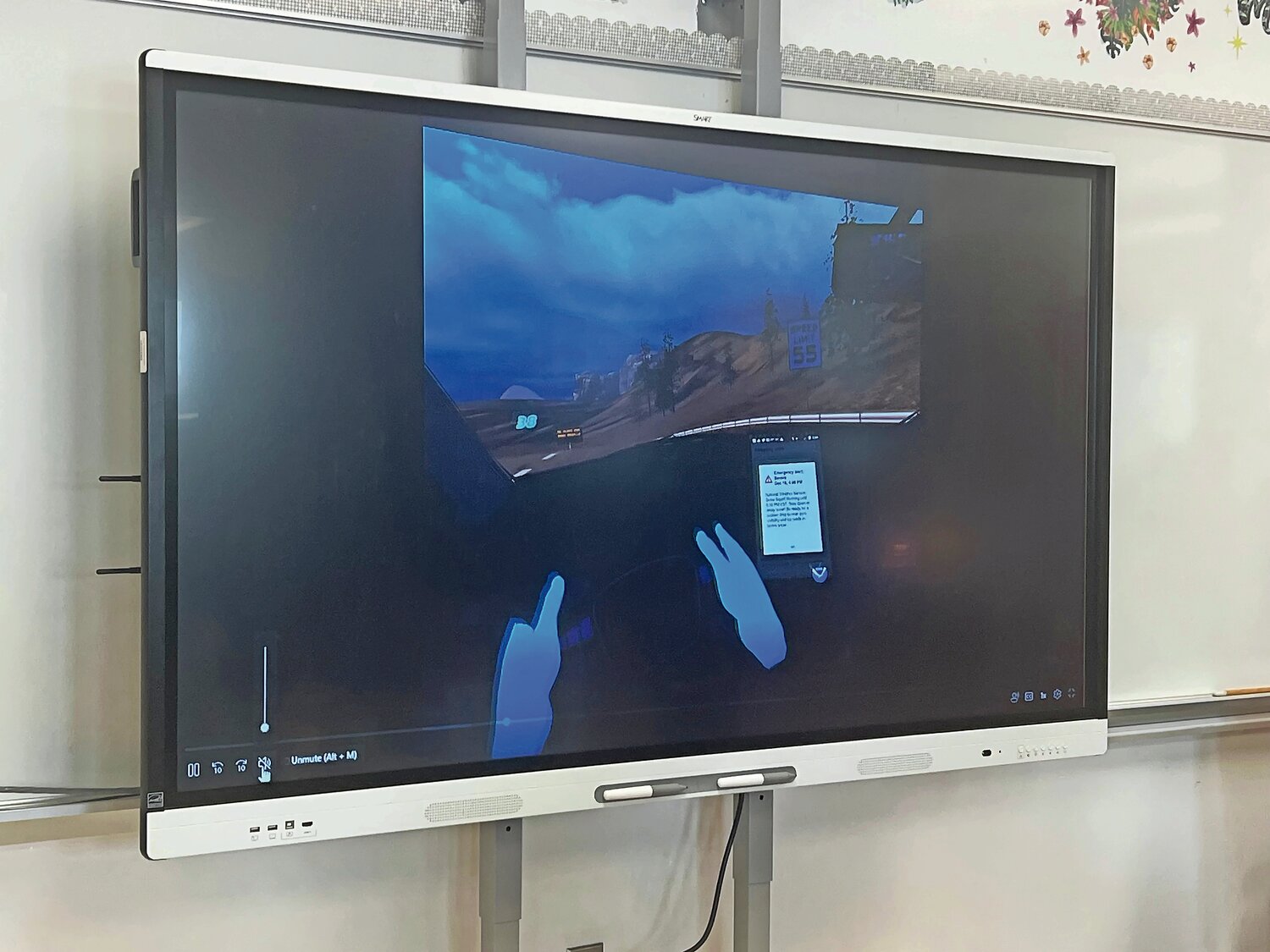


Oceanside High School junior Kritika Kumar has created a 3D virtual reality simulation of driving through a snow squall, demonstrating how to use the potentially life-saving technology during her science class on Oct. 15.
The 16-year-old student’s VR simulation is significant because it’s important to know how to respond if caught in a squall — a sudden heavy snow with high winds and whiteout conditions, often leading to driving hazards and safety concerns.
“The purpose of this study was basically to survey and interview individuals who participated in the simulation, to see what they thought of the simulation, how they felt, like their feedback,” Kumar said. “And it was trying to see the effectiveness on increasing awareness of the participants’ knowledge on snow squalls and if they improve their evacuation methods during a snow squall.”
The VR simulation allows users to experience a snow squall and practice safely exiting the particular weather condition while learning proper safety precautions for the upcoming winter season. The simulation was created using a coding program called Unity 3D. Once the VR headset is in place, the user is instantly “transported” to a virtual car and becomes the driver.
The simulation takes the user on a drive down the road, similar to a video game, when a snowstorm alert begins. While the snow begins to fall, and at a rapid rate, the user has the opportunity to exit the highway safely before the chance of driving into a pile of cars. If a car pile arrives, a message on the screen will appear after the collision, with tips on following safe measures to either exit or avoid physical harm.
Jase Bernhardt, an associate professor in Hofstra University’s department of geology, environment and sustainability, was Kumar’s mentor on the project, and their collaboration was part of a summer research initiative through Hofstra.
“We worked with a developer that mostly codes it, with input from myself and other experts, (and) the National Weather Service meteorologists, who work closely with us to make sure it looks realistic,” Bernhardt said. “We spoke with some Department of Transportation folks to make sure the driving and the roads and all that looked realistic as well.”
To ensure accuracy, a survey was taken before and after using the simulator to gauge snow squall awareness and feedback.
“Participants took a survey of their prior knowledge of snow squalls and also how they thought about the snow squalls and VR feedback,” Kumar said. “Many individuals thought that visibility was most important.”
The survey compared both English and Spanish-speaking students. “A lot of the English speakers had said that the simulation was very effective in depicting snow squalls, and it was effective in also teaching the evacuation methods,” Kumar said. “However, some other individuals had noted that the VR was hard to control. But despite these limitations, many individuals across the entire survey, or the participants, thought it was very immersive and effective.”
The simulation was part of Hofstra’s Summer Science Program, which involved three high school students of different districts. These students worked throughout the length of the program to now on the simulation.
“They encourage us to allow students to work with real-world data and research and everything,” Bernhardt said. “It’s great, because this is the next generation of scientists.
“So, we want to train them early on to get them into STEM because there’s so many different possible career options for talented students, and to encourage them to go to STEM,” Bernhardt added, in referencing Science, Technology, Engineering and Mathematics.
This project marks only the beginning of Kumar’s future goals in the science field, because she holds plans to pursue research in college..
“I want to probably go into the medical field, and I’m really interested in learning about new stuff,” she said. “Although this isn’t greatly science-related, I wanted to branch out and try virtual reality, and expand my knowledge on things other than just direct science.”


