
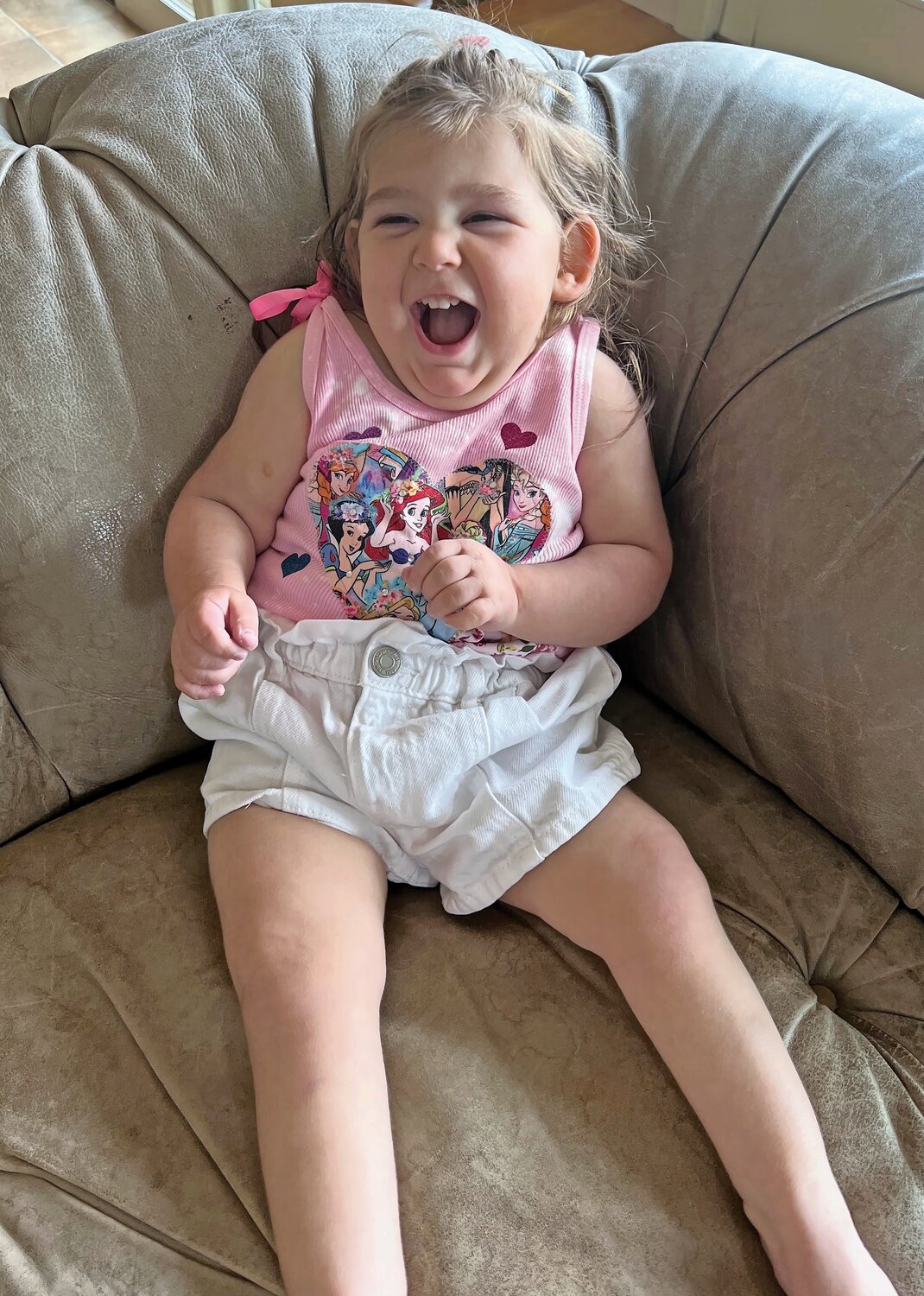


After achieving remarkable success last year through community donations, Laps with Lizzie is preparing to host its first fundraising walk. The inaugural event will take place Oct. 25 on the Long Beach Boardwalk.
The Woroniecki family of Bellmore, who raised nearly $30,000 last year and have already reached $18,000 this year, continues to turn their personal story into a movement for awareness.
The fundraiser was created in honor of 3-year-old Lizzie Woroniecki, who was diagnosed as an infant with a rare neurological disorder, Aicardi-Goutières Syndrome, which affects the brain, spinal cord, and immune system. Her mother, Rebecca, started the fundraiser to support research at the Children’s Hospital of Philadelphia, a leading center for AGS research and care.
“No one really knew except for close friends and family. So, for her second birthday, I wanted to do something positive with it,” Woroniecki said. “I put my grief into doing something positive. This is the only way I can cope with everything.”
That motivation led Woroniecki to launch a social media fundraiser last year, which received overwhelming support from the community.
“It was such a great turnout,” she said. “I wanted to make something annual, and that’s how the walk came to be.”
While AGS has no cure, ongoing research at CHOP aims to develop gene therapy and add AGS to newborn screening programs — something Woroniecki says could make a life-changing difference for other families.
“I know there needs to be research done to help other families, help other kids and the future with those who have AGS,” Woroniecki said. “All money goes toward research for AGS through the Children’s Hospital of Philadelphia.”
With new technology and medical innovations emerging, increased funding for programs that support early diagnosis of AGS — especially early-onset cases like Lizzie’s — could greatly improve quality of life for patients and their families.
While most AGS cases are linked to inherited genetic mutations, Lizzie’s was caused by a rare, random mutation, making early screening and access to gene therapy all the more vital for future children.
“[AGS] could be part of newborn screening,” Woroniecki said. “[Children] could be on medication, so it doesn’t do as much damage as it has done to Lizzie.”
So far, Woroniecki said 93 participants have registered, and the first 100 to sign up will receive a free T-shirt. She also reached out to children’s clothing and toy stores to donate items for raffles at the fundraiser.
Lizzie’s health journey began before she was born. From her premature birth to the nine days she spent in the neonatal intensive care unit, the Woroniecki family sensed something was not right. But for the first six months of her life, their concerns went largely unaddressed.
“During my pregnancy, I had a growth restriction called IUGR, but 99 percent of the time it’s nothing to worry about,” Woroniecki said. “I got induced at 37 weeks because of her birth weight — she was four pounds, six ounces. And she went right into the NICU because of her temperature, which was very low, so they wanted to keep her overnight.”
For months, Woroniecki and her husband searched for answers as Lizzie struggled to hit developmental milestones.
“She was irritable, crying nonstop, and the doctors kept saying it was colic,” she said.
After a series of specialist visits, tests and early intervention evaluations, Lizzie was diagnosed at eight months old with AGS. After receiving the results, all the doctors told the family they needed to go to CHOP.
Woroniecki remembers hearing “CHOP, CHOP, CHOP” from the neurologist and geneticist. At the children’s hospital, Lizzie began a treatment regimen that included baricitinib, a drug first approved for rheumatoid arthritis that has been repurposed to help slow the progression of AGS in pediatric patients. Her follow-up visits, once every three months, are now spaced out to every six months as the medications continue to help.
“It doesn’t cure it, because there is no cure, but it helps,” Woroniecki said. “She’s now less irritable, happier, and she laughs.”
Woroniecki relies on her family and community to help her stay strong through the challenges of Lizzie’s diagnosis.
“I would not be able to do this without my family or friends, especially my parents,” she said. “They have been to every doctor’s appointment with us in Philadelphia; they even flew up from Florida to come with us.”
The kindness of her community has made all the difference. Woroniecki said the love and inclusion from friends have made an incredible impact on her family.
“We go to music with our friends. She goes to other birthday parties, gets invited to birthday parties, and we go to the beach with our friends,” she said. “No one treats her any differently, which is what I love.”
Her younger daughter, Abigail, now 18 months old, has also become one of Lizzie’s biggest supporters.
“She’s very protective of Lizzie,” Woroniecki said.
Woroniecki hopes Laps with Lizzie will continue to grow each October, inspiring more families, pediatric patients, and community members to support those diagnosed with AGS.
Registration for the inaugural Laps with Lizzie walk is open at RunTheDay.com/register/detail/1st-annual-laps-with-lizzie-walk, and donations can be made at Chop.DonorDrive.com/campaigns/LapsWithLizzie_Woroniecki.


