

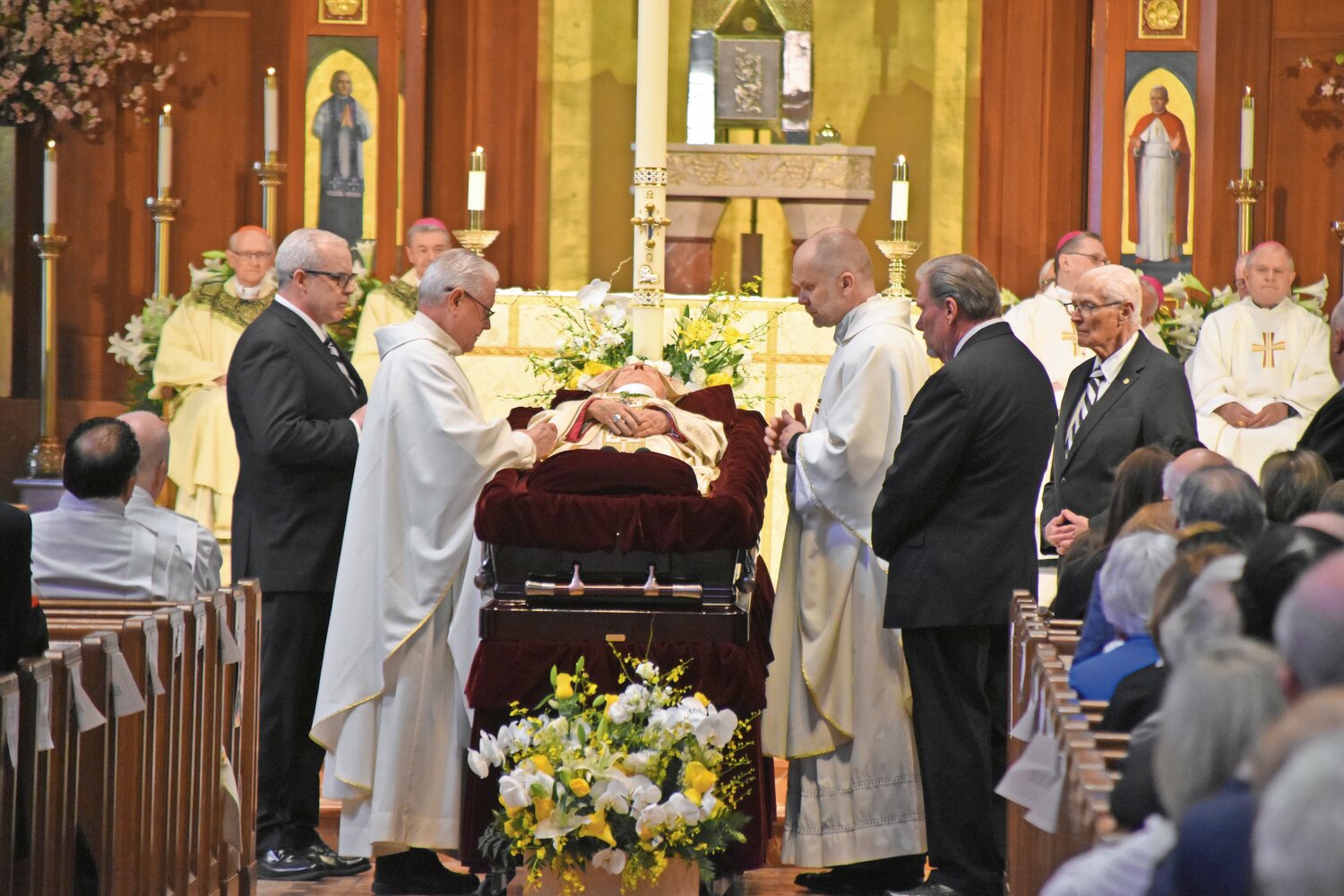


Roman Catholics from Rockville Centre and beyond gathered at St. Agnes Cathedral for the funeral rites of Bishop Emeritus William F. Murphy, who died on March 26 at the age of 85.
The Diocese of Rockville Centre marked his passing with two days of prayer, remembrance, and liturgical celebration honoring the longtime bishop’s life and ministry. Murphy served as the fourth bishop of the Diocese of Rockville Centre from 2001 until his retirement in 2017, leading one of the largest Catholic dioceses in the United States.
The last diocesan funeral for a bishop at St. Agnes Cathedral before Murphy was for Bishop James T. McHugh, who died on Dec. 10, 2000.
The funeral observances began on April 6 with the reception of the body in the morning, followed by a public viewing that continued into the afternoon and evening, and the Mass of Transferral that night. The following day included a final public viewing before the community gathered in the afternoon for the Mass of Christian Burial, the concluding liturgy of farewell before his burial at Queen of Peace Cemetery in Old Westbury.
Murphy’s body lay in a slightly angled open casket at the foot of the altar during both services, which were led by Bishop John O. Barres, who succeeded Murphy in 2017.
The 90-minute Mass of Christian Burial on April 7 opened with about 150 clergy members—including priests, deacons, archbishops, bishops from other dioceses, and women and men religious—processing down the aisle as the opening hymn played, while dozens of family members, friends, and other mourners looked on.
Barres then recited a prayer, giving thanks to Murphy for his “missionary spirit and all he has taught us through the power of the risen Christ.” Father Eric Fasano, vicar general and moderator of the Curia, read a letter on behalf of Cardinal Pietro Parolin, the Vatican Secretary of State, and Cardinal Christophe Pierre, the Apostolic Nuncio to the United States, offered in the name of Pope Leo XIV.
Bishop Robert J. Brennan’s homily reflected on Murphy as a deeply committed servant of the Church who found his greatest joy among the people he led, especially in parishes, schools, and alongside his fellow priests. He emphasized Murphy’s love for the Church, his pastoral presence, and his dedication to guiding others toward a deeper relationship with Christ, portraying him as both a leader and a unifier shaped by faith, service, and humility.
“He loved being in parishes and schools among the people, and he loved his priests very much,” Brennan said. “He was always so impressed by who you are, how you serve God’s people, and the depth of your faith. He simply loved being with you.”
Following the Eucharist, two priests removed Murphy’s miter and placed it at his feet. The pallbearers then lowered the head of the casket and closed it for the final time.
Barres thanked those who attended and reflected on Murphy’s legacy, saying, “Most of us here today have a good sense of Bishop Murphy’s biography and the incredible range of ways he served the mission of the Church that Bishop Brennan captured so well. Bishop Murphy was an ecclesial meteor. But since his death, so many stories and anecdotes have been shared that have helped us to synthesize and understand at a deeper level just how much he loved and served Christ and the mission of the Church.”
Cardinal James Harvey, Archpriest of the Basilica of Saint Paul Outside the Walls in Rome, traveled from Italy to attend the funeral and remembered Murphy as a longtime friend whose defining quality was joy, describing him as warm, generous, and deeply faithful.
“The first word that comes to my mind when I think of Bishop Murphy is joy,” he said. “His joy for life was irrepressible.”
Harvey then sprinkled the casket with holy water and incensed it as clergy participated in the Final Commendation and Farewell, singing a hymn before an icon of the Virgin Mary, the Christ Child, and Saint Joseph.
After the clergy processed out of the sanctuary, six pallbearers carried the casket to a waiting hearse, which transported Murphy’s body to the cemetery as mourners stood outside.


