
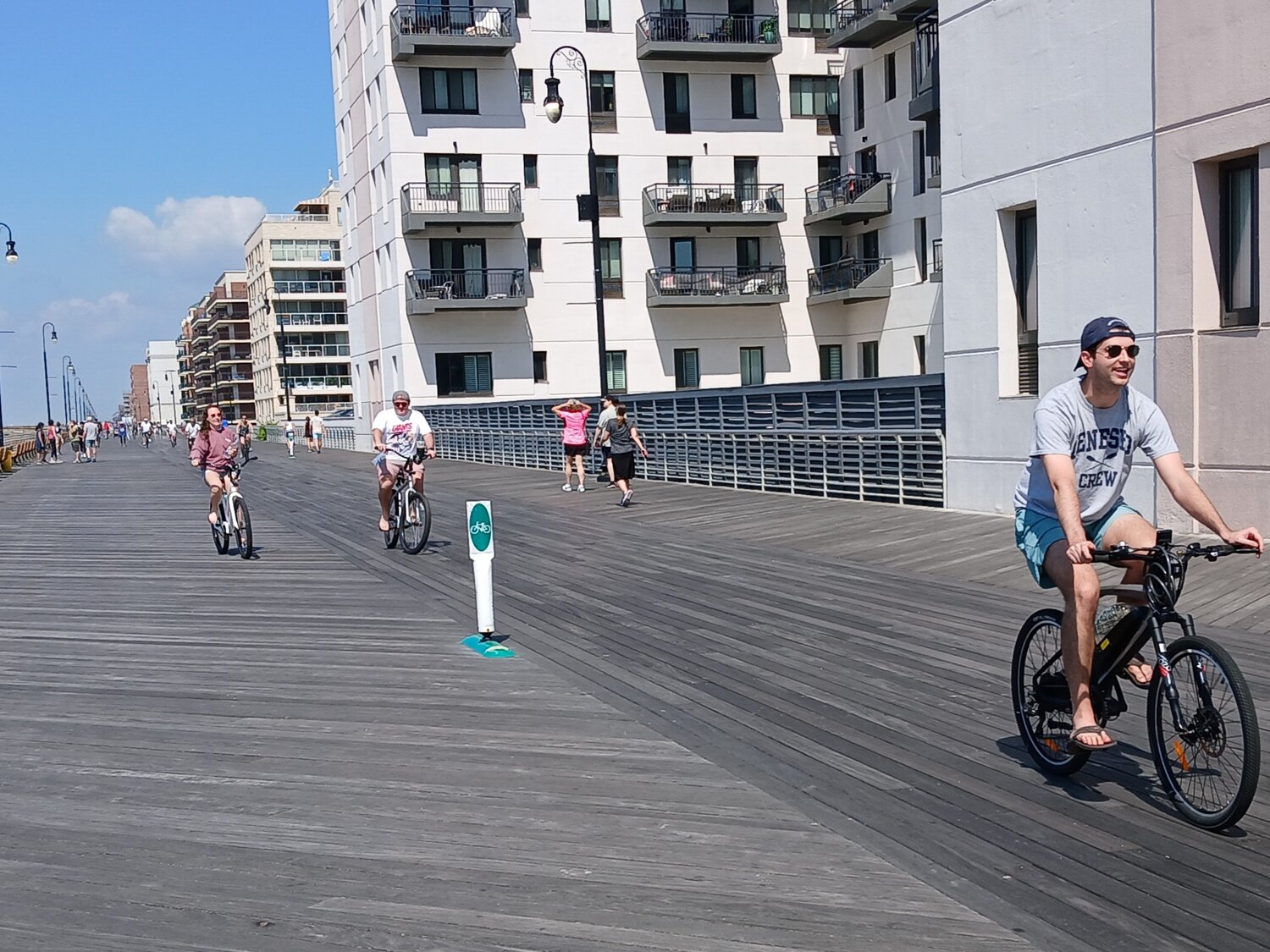


Boardwalk regulars are familiar with the structure’s rules: walkers and joggers on either side, bike riders in the middle. Now Long Beach has added a new regulation, to deal with the proliferation in recent years of a new kind of vehicle: e-bikes. Their use is now prohibited on the boardwalk.
At its June 2 meeting, the City Council voted unanimously to modernize the language in the city’s code of ordinances. As it is currently written, the law restricts “wagons, horses, carts, automobiles, motorcycles and motorized bicycles” from operating on sidewalks, the beach or the boardwalk. It will now outlaw e-bikes as well as electric and motorized scooters.
That ordinance subsection was first enacted in 1968, and has been updated several times over the years, most recently raising fines for scofflaws in July 2024. Previously, the ordinance had only explicitly prohibited the use of “motorized bicycles.”
In March, Nassau County Executive Bruce Blakeman passed legislation banning Class 2 and 3 e-bikes — which can reach speeds of 20 and nearly 30 miles per hour, respectively. The city ordinance will now restrict Class 1 e-bikes as well, which can approach 20 mph when the rider is pedaling, unlike Class 2 bikes, which use a throttle. Penalties can include fines ranging from $50 to $500, imprisonment up to 15 days, or both.
Several attendees at last week’s meeting said they were concerned that the language of the restriction could potentially affect boardwalk and beach access for people who use mobility aids, and questioned the city’s adherence to the Americans with Disabilities Act.
“Passing an ordinance that does not have any exception, and denies people with disabilities access to the bike lane, is going to come under question,” said Dave Skudin, a longtime resident and the patriarch of Skudin Surf. “I’m not a lawyer, but I have talked to people who are, and a couple of them said this is a gold mine for a lawyer.”
The city’s corporation counsel, Greg Kalnitsky, explained the strength of the regulation. “Courts have upheld blanket prohibitions under certain circumstances for e-bikes,” Kalnitsky said. “They’ve upheld those prohibitions where you’re dealing with a crowded area where usage of those devices presents a legitimate and real safety issue.”
Kalnitsky also referred to existing precedent for the ban, explaining that Walt Disney World maintains a ban on e-bikes throughout its properties, and has not had issues with ADA compliance.
Police Commissioner Richard DePalma said the department received thousands of complaints last year about irresponsible e-bike riders creating an unsafe environment on the boardwalk. “There’s a great amount of people in a small area and there’s no way to escape,” DePalma said. “If there’s an e-bike going at a fast speed, there’s less of an opportunity for people to get out of the way and it’s just a dangerous situation.”
Councilman Michael Reinhart also emphasized the potential dangers, reminding attendees that a pedestrian, 68-year-old Barry Spigner, of Long Beach, was struck and killed by an e-bike on East Park Avenue last year.
DePalma explained that the primary method for enforcing the updated regulations will be educating the public with signs and postings on social media. Summer Specialist officers and increased police presence at checkpoints along the boardwalk will also be essential for enforcing the law.
The council also amended the ordinance that prohibits anyone over age 10 from riding conventional bicycles on Long Beach sidewalks, to include e-bikes, electric scooters and motorized scooters. This prompted residents to raise the topic of street safety for bicyclists, which sometimes prompts riders to retreat to the sidewalks.
“The cars are the dangerous thing for bikers,” former councilman Roy Lester said. “I bike with a group, and every person in that group has been hit by a car. Every single one. That’s where the danger is. And I’ve said for 20 years, let’s get bike lanes.”
Another update that will affect bicyclists throughout the city restricts the ways in which bikes can be secured. Bikes, e-bikes and similar vehicles may not be locked to trees, poles, signs, fences or other objects unless the area is specifically designated for that purpose.
On the boardwalk, the ordinance now states, bikes may not be locked along entrance ramps or walkways, nor on the south side fencing, closest to the beach. Affixing bikes to the north side fencing is permitted where it doesn’t obstruct pedestrians, entrances or access points. And bikes and similar vehicles left secured in one place for more than 24 hours risk being impounded by the LBPD.


